|
|
Town House
For Plans, measurements and other photographs of the Town House, click here.
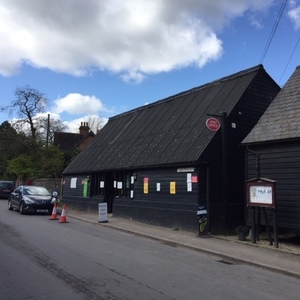
History : Facilities : Rates of Hire : Letting Conditions : Weddings : Contact : Home Page HistoryThe Town House (which means Community or Peoples House) is one of the oldest buildings in the village. The building has belonged to the village for nearly 500 years. It is now the village hall and must be one of the oldest village halls in the county, if not the whole country. The Town House is described in Norden's late 16th century Survey of Barley as 'The Court House of the Manor of Mincinbury, formally in the occupation of the vill or inhabitants of Barley, situated opposite the church there, which the lord now uses to hold the manor courts of Mincinbury'. This was one of three manors at the time, but the 'lord' was not to have possession of the Town House for long. Evidently the people of Barley had protested against the attempt of the new lord of the manor to usurp their rights. At a court held at Buntingford in 1609 the jury decided that the Town House was to be used 'for the poor inhabitants, for their marriages, to collect and cause by meeting, the gifts of the charitable people to be obtained towards the help and relief of the poor inhabitants within the said town ..... and also for a school house, and so it has been for time out of mind until the late Sir John Spencer Kt, Alderman of London, has made claim to the said house'. Sir John and his heirs were ordered not to 'vex the parishioners in their holding'. The Buntingford charities inquisition of 1638 gave the Town House date as 1530 and stated 'the saide house hath been tyme out of mynde used and ymploied for the keeping of maides marriages therein and for the hangeing up of the Town Arms therein, and for the chief inhabitants there to mete and consult of the affairs and common busynesses of the Town of Barley'. The Rector stated that 'keeping of maides marriages' meant homes for spinsters and not wedding celebrations.
In 1726 Daniel DeFoe wrote a book on his Tours of Britain. In his description of the Town House he wrote: upstairs there is a large room for entertainment feasting and merriment; a small room to the side for the preparation of food with a spit, large cauldron and dripping pan; a room at the end of the main room which contained a bride bed and good linen, for the couple to spend their first night to consummate their wedding! The building continued to be used as a school, though learning seems to have been at a low ebb in 1779 when the schoolmaster complained that as only two free scholars came to the school he had a bare two shillings a week 'which is, in a manner of speaking, a starving situation'. Though used as a school during the 17th century, hardship caused by the Civil War and the Napoleonic Wars later meant that any extra mouths to feed aggravated the already heavy burden of the Poor Rate. The Town House ceased to be used as a school and became a workhouse. Any 'foreigners' who were likely to be a charge on the parish were sent back to their native villages. Wars indeed caused a lot of family distress and this was aggravated in Barley by the pulling down of the cottages in Little Chishill to avoid the Poor Rate, but the census of 1841 shows most of the people living in the Town House at that time to have been born in Barley, so even if the cottages were destroyed it is doubtful if the tenants were re-housed in Barley. However, at one time men, women and children were herded together in the big room, with a madman, on one occasion, chained to the wall at one end. There were 28 paupers accommodated there at one time and in 1853 36 people were living in the Town House as a workhouse when the Rev R A Gordon was appointed Rector and he had them accommodated elsewhere, possibly in Royston, where Heath Lodge had been built in 1835 to cater for the surrounding villages. School matters were little better in the middle of the 19th century, over half the people getting married being unable to sign their name. Considerable alterations to the Town House were made so that it could be used as a school again and it had 140 scholars when it reopened. An interesting relic of the building's use as a school was the second lower stair rail on the staircase nearer the church. Towards the end of the 19th century difficulties arose over the continued use of the Town House as a school. On one occasion ink froze in the inkwells, in spite of two large fires. The authorities wanted to pull down the Town House and build a new school on the site. Luckily this was rejected and the present school came in to use in a building next door to the Town House on 22nd April 1895. However, the Town House was pressed into educational services as recently as the 1940s when evacuees from London swelled the numbers. "The Scholars attending Barley Schools left their old quarters in the 'Town' House and walked in procession , headed by the Royal Standard and Union Jack flags to the present School. The Rector - the Rev J Frome Wilkinson - addressed them on the importance of learning as a means of training them for a useful sphere in life, the observation of punctuality, and regular attendance, attention to school duties and obedience to their teachers. The children then settled down to work." The rooms underneath were last occupied about 1870 when the occupants were moved out as they were apt to set themselves or the building on fire. The small room was added late in the 17th century and was used by the boys and girls for their cloaks and hoops when the Town House was used as a school. It was enlarged in 1863 by means of a fund raised among farmers and landowners with a substantial contribution from the Rev Gordon. A second staircase was put at the back of the Town House and dormer windows added when the small room was enlarged, but this staircase was replaced by the one at the end nearest the present school in 1910. A drawing of about 1850 shows a staircase in the middle of the south front facing the road. This must have been removed when the dormer windows were put in. A further use was found for the building when a manual fire engine was housed on the ground floor in 1913. A sketch of the Town House dated about 1835 shows a central chimney stack in addition to those at each end. This was later removed, but it is from the time when the ground floor was divided in to living quarters, each with its own fireplace. The twin fireplace in the smaller downstairs room and the dividing wall are the remaining evidence of this use of the building. The church connection with the building and its history has continued until very recently when the Rector, Canon Locket, an architect prior to entering the Church, was responsible for the last refurbishment of the ground floor or Undercroft in 1980-81. The work of a dedicated band of village people augmented that of the builders in a transformation of a derelict ground floor into the comfortable rooms that are to be seen today.
These improvements included: more male and female toilets - plus one for the disabled, replacing the internal stairs with a landing at the top, re-equipping the upstairs kitchen and constructing a new small kitchen downstairs, the construction of an additional store, a new rear access with wider doors and the widening of an internal door - bringing all downstairs floors to the same level. In 1996 the Town House was the first village hall in the country to be licensed for civil marriages. On 11th May the first marriage took place. Philip Wilde For Plans, measurements and other photographs of the Town House, click here.FacilitiesThe Town House is on two floors. The ground floor or Undercroft has two rooms, the main room, a smaller side room (committee room) with a small kitchen attached. Also downstairs off the main entrance area are the toilets, male, female and disabled. Upstairs on the first floor is the main room, which spans the entire building. Off this room is a larger kitchen. There are noise limiters in both main rooms. UndercroftMain room - licensed for civil marriages Committee room Kitchen Upper FloorMain room Kitchen Rates of HireNB, the charges are still correct as of 25/09/2007 but they are under review at this moment. Those who have paid their deposit to hire the hall will (probably) still be paying the displayed prices but those who have not may be subject to whatever increase is added to the current figures. For Plans, measurements and other photographs of the Town House, click here.
For evening bookings which have a disco or live music and which are due to finish later than 11.00pm there will be an extra charge of £100 to cover caretaking costs. Special Rates Local organisations/charities by arrangement with the Letting Officer. Deposit A deposit, returnable only after the event will be required on confirmation of booking. Hall Capacity Upper Floor 120 ( 100 can be seated for eating ) The Town House reserves the right to vary these charges from time to
time. Special Rates Local organisations / charities by arrangement with the Letting Officer. Deposit A deposit, returnable only after the event will be required on confirmation of booking. For Plans, measurements and other photographs of the Town House, click here.Letting Conditions
For Plans, measurements and other photographs of the Town House, click here.
WeddingsThe Town House is ideal for a wedding reception or the ceremony itself. With the Undercroft licensed for civil ceremonies, accommodating up to 70 guests, you can have the reception afterwards and dance the night away upstairs without expecting your guests to travel. The beautiful 16th century building is ideal for the wedding of your choice. You choose the caterers, flowers, photographer, we provide an attractive and romantic setting. For help with your wedding needs ask the Lettings Officer for suggestions of local businesses who are tried and tested and know the Town House.
Contact the Letting OfficerMrs Alison
Stacey
Alison's Email:
alistacey2004@aol.com For Plans, measurements and other photographs of the Town House, click here.Pictures by Courtesy of Gordon Brown (notTHAT Gordon Brown!)FIBA, LBIPP, LSWP Gordon Brown has specialised in photographing people for over 30 years and has established a reputation for high quality, natural wedding and portrait photography at realistic prices, coupled with a truly personal and professional service. Many hundreds of wedding couples have been carefully and creatively captured through the lens of one of his Hasselblad cameras. Portrait assignments are handled in his superb 600sq ft studio or in the grounds of his countryside home at Bilden End, just off the B1039 mid-way between Royston and Saffron Walden or at an alternative location by arrangement. Gordon Brown is well known for high standards or integrity and professionalism and is pleased to supply details of many assignments recently handled. The Studio | |||||||||||||||||||||||||||||||||||||||||||||||||||||||||||||||||||||||||||||||||||||||||||||||||||||||||||||||||
|
|